Canada Eyes EU Ukraine Loan as Ottawa Seeks More Leverage Beyond Washington
Ottawa is negotiating a role in the European Union’s €90 billion Ukraine loan program before an EU-Canada summit in Montreal.
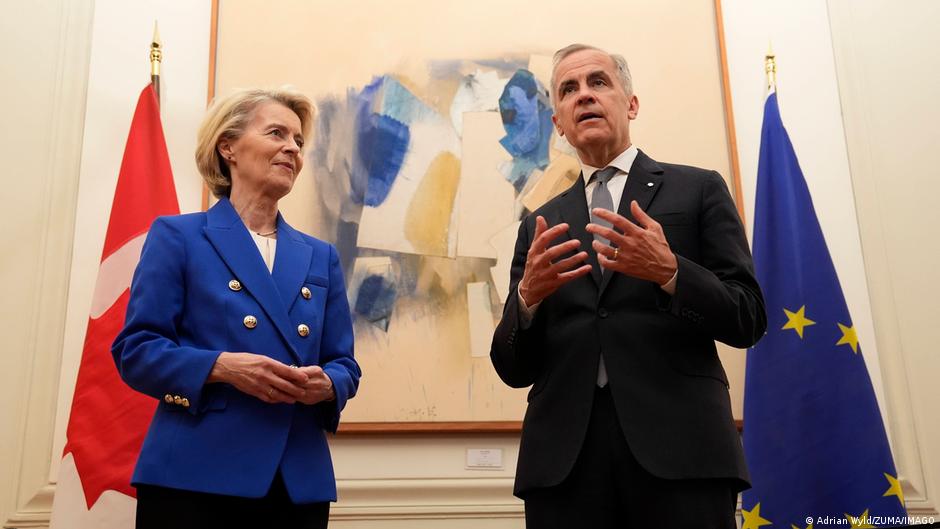
Canada is seeking to join the European Union’s €90 billion loan program for Ukraine, a move that would deepen Ottawa’s financial commitment to Kyiv while signaling a broader effort to rebalance its foreign and economic policy away from heavy reliance on the United States.
The talks, reported Sunday, September 13, by the Financial Times citing people familiar with the matter, are aimed at settling the size of Canada’s contribution before the EU-Canada summit scheduled for late October in Montreal. If completed, the arrangement would make Canada part of a major European-backed credit initiative designed to support Ukraine as the war continues to strain Kyiv’s budget, defense sector and reconstruction needs.
For Washington, the Canadian move carries implications beyond Ukraine funding. It comes as Prime Minister Mark Carney looks to demonstrate to Europe that Canada is committed to strengthening transatlantic ties, even as Ottawa seeks to reduce its dependence on the United States. The Financial Times described Carney’s broader idea as building an alliance of liberal powers committed to a multilateral order that it said had been disrupted by U.S. President Donald Trump.
Canada’s potential contribution is expected to be negotiated before the late-October EU-Canada summit in Montreal.
The United Kingdom is currently the only non-EU country to have joined the loan program. Canada’s participation would therefore expand the initiative’s political reach and give Brussels another partner from outside the bloc at a time when Ukraine financing is increasingly tied to questions of burden-sharing among Western allies.
Washington Watches a North American Partner Look to Europe
From a U.S. business and politics perspective, the talks underscore a shift that American executives and policymakers will need to track closely. Canada remains one of the United States’ largest trading partners and a deeply integrated part of North American supply chains. But Ottawa’s pursuit of closer arrangements with Brussels suggests that Canadian officials are looking for additional leverage in a period of tense trade relations with Washington.
According to the Financial Times account cited in the Russian-language source, Canada is seeking support in a trade war with the United States and hopes to conclude other agreements with the European Union. Those efforts include a possible move to join the EU’s network of supercomputers for joint work on artificial intelligence, as well as a digital trade agreement with Brussels.
For American companies, the bottom-line significance is not limited to Ukraine financing. If Canada deepens digital trade, artificial intelligence and defense innovation ties with Europe, U.S. firms could face a more complex competitive environment in sectors where Washington has long counted on North American alignment. Technology companies, cloud providers, AI infrastructure firms, cybersecurity vendors and defense contractors may all have reason to monitor how far Ottawa’s EU strategy goes.
At the same time, Canadian participation in a Ukraine loan program could help distribute the fiscal and political burden of supporting Kyiv more broadly across allied economies. That may be welcomed by U.S. lawmakers and businesses that favor continued support for Ukraine but want other partners to shoulder more of the cost. It could also give Canada a more visible role in shaping Ukraine-related procurement, reconstruction planning and defense innovation partnerships.
Defense Innovation and Long-Term Commitments
Ottawa has already allocated 6.5 billion Canadian dollars in military assistance to Ukraine, equivalent to about $4.7 billion. On September 10, Carney and Ukrainian President Volodymyr Zelensky signed a declaration on a 100-year partnership that includes cooperation in defense innovation, according to the source article.
That long-term framing matters for defense and industrial policy. A century-scale partnership is not simply a wartime gesture; it points to sustained cooperation in areas that could include military technology, procurement, research and development, and the modernization of Ukraine’s defense base. For U.S. defense companies, the emergence of stronger Canada-Ukraine and Canada-EU channels could create both opportunities and competitive pressure, depending on how procurement standards, export controls and joint innovation programs are structured.
The political backdrop is equally important. Carney’s push to strengthen links with Europe is described as part of an effort to reduce Canadian dependence on the United States. For American policymakers, that is a warning sign about the effects of trade conflict on alliance management. If disputes with Washington encourage close partners to accelerate economic and strategic diversification, the United States may retain its market power while losing some influence over the rules and partnerships that shape future growth industries.
The proposed cooperation on EU supercomputers and artificial intelligence is especially relevant to U.S. companies. AI development depends on access to advanced computing capacity, data governance frameworks, talent pipelines and cross-border research partnerships. If Canada aligns more closely with Brussels on digital trade and computing infrastructure, American firms operating in Canada may need to adapt to regulatory expectations shaped more by European standards than by U.S. market practice.
None of the reported talks appears finalized. The size of Canada’s potential contribution to the EU loan remains under negotiation, and the parties are aiming to reach agreement before the Montreal summit. But the direction is clear: Ottawa is using Ukraine support, trade policy and technology cooperation to reposition itself among liberal democracies at a moment when U.S. politics and trade tensions are testing long-standing assumptions about North American alignment.
For Ukraine, Canadian participation would add another source of support to a major European lending initiative. For Brussels, it would broaden the coalition behind the program beyond EU institutions and the United Kingdom. For Washington and U.S. business, it is a reminder that trade pressure on allies can carry strategic costs, particularly when those allies have alternatives in Europe and incentives to build them quickly.