North Korea Fires Ballistic Missile as Peninsula Tensions Test Washington
Seoul said Pyongyang launched at least one ballistic missile toward the Sea of Japan after a border blast injured South Korean troops.
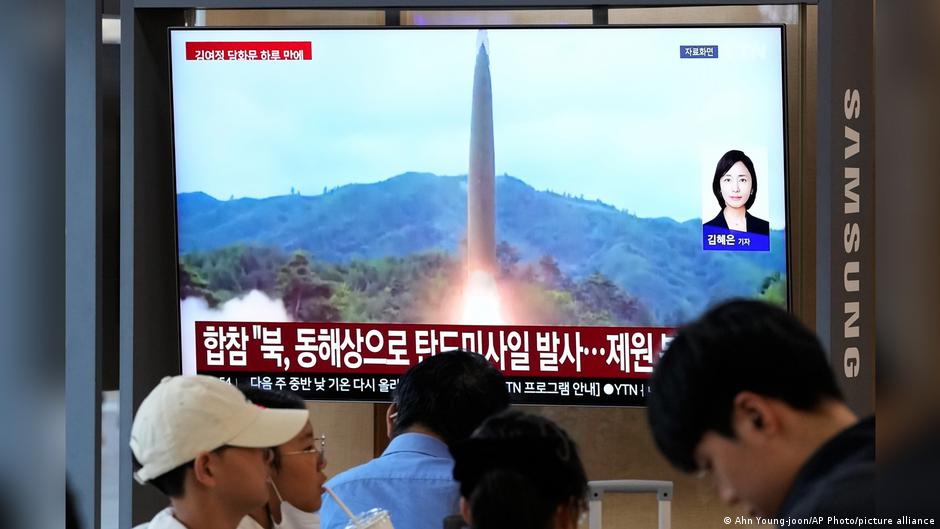
North Korea fired at least one ballistic missile toward the Sea of Japan, South Korea’s military said Saturday, October 3, adding a fresh security test for Washington and its allies at a moment when geopolitical risk is again moving into the foreground for U.S. policymakers and companies with exposure to East Asia.
South Korea’s Joint Chiefs of Staff said Seoul, Washington and Tokyo were maintaining a high level of readiness while closely sharing information on North Korean ballistic missiles. The launch followed a separate incident in the border zone between North and South Korea on September 21, when an explosion injured three South Korean service members.
“South Korea, the United States and Japan are maintaining a high level of combat readiness while closely exchanging information on North Korean ballistic missiles,” Seoul said in its statement.
For the United States, the immediate question is military coordination with two treaty allies, South Korea and Japan. But the broader significance extends into business planning, market risk and supply-chain resilience. The Korean Peninsula sits alongside some of the world’s most important industrial and technology networks, including semiconductor production, shipbuilding, batteries, autos and advanced electronics. Any escalation, even short of open conflict, can raise costs for insurers, logistics providers and multinational companies that depend on predictable routes and stable regional politics.
Washington Faces Another Alliance Stress Test
The missile launch comes after Seoul accused Pyongyang of violating the armistice that ended active fighting in the Korean War. South Korean military sources, cited by AFP, said the September 21 blast was believed to have been caused by the detonation of North Korean anti-personnel mines. South Korean Defense Minister Kang Shin Chul accused Pyongyang of breaching the armistice and said Seoul intended to take countermeasures. The Joint Chiefs of Staff demanded an apology from North Korea.
North Korea rejected the accusation. Kim Yo Jong, the sister of North Korean leader Kim Jong Un, called the South Korean claim “extremely low and dirty,” according to remarks carried by North Korea’s state news agency KCNA.
The exchange underscores the persistent instability of the armistice system on the peninsula. South and North Korea are still formally at war: the 1950-1953 Korean War ended with an armistice agreement, not a peace treaty. The two countries are separated by the Demilitarized Zone, a heavily fortified and mined strip of land through which the Military Demarcation Line runs. It is one of the most fortified and heavily mined borders in the world.
That unresolved status matters for Washington because U.S. forces remain central to deterrence on the peninsula, and because American strategy in Asia increasingly depends on tighter coordination among the United States, South Korea and Japan. Seoul’s statement emphasized trilateral information sharing, a signal that the three governments are treating North Korean missile activity as an allied security problem rather than a bilateral Korean issue.
Business Risk Beyond the Battlefield
For U.S. businesses, the launch is another reminder that security developments in Northeast Asia can quickly become operational concerns. South Korea is deeply embedded in global manufacturing networks, especially in sectors that matter to American corporate earnings and national industrial policy. U.S. companies sourcing chips, components, vehicles, batteries or shipping services from the region must account for political risk that can affect contracts, delivery schedules and financial hedging.
The Sea of Japan, toward which South Korea said the missile was fired, is also part of a wider maritime environment critical to trade among South Korea, Japan and other regional economies. The report did not specify the type of ballistic missile, its range, flight time or landing area. Still, even limited launches can prompt emergency monitoring, diplomatic coordination and market attention, particularly when they occur in close sequence with border incidents.
American firms rarely make investment decisions based on a single launch, but repeated missile activity can influence the assumptions behind long-term capital allocation. Companies may reassess inventory buffers, regional redundancy, crisis communications and employee safety protocols. Financial institutions may also factor renewed tensions into country-risk analysis, currency expectations and exposure to defense, shipping and technology sectors.
The episode also lands in a U.S. political environment where Indo-Pacific security is linked to industrial competitiveness. Washington has encouraged closer alignment with allies on defense, technology controls and supply-chain security. North Korean missile activity strengthens the argument in Washington for continued military readiness and deeper intelligence cooperation with Seoul and Tokyo, while also increasing the pressure on policymakers to protect American business interests tied to the region.
At the same time, the facts reported by Seoul remain narrow: North Korea launched at least one ballistic missile toward the Sea of Japan; South Korea, the United States and Japan are sharing missile information and maintaining readiness; and the launch followed a disputed border explosion that injured three South Korean troops. North Korea denies responsibility for the earlier incident and has rejected Seoul’s claims in unusually sharp language.
That combination of military signaling, denial and alliance coordination is familiar on the peninsula. What makes it consequential for U.S. readers is the convergence of security and commerce. A crisis around Korea would not stay confined to defense ministries. It would touch American boardrooms, supply-chain teams and investors whose bottom lines depend on stability in one of the world’s most economically important regions.