Trump AI accord puts safety oversight largely in hands of major tech firms
A White House agreement with Google, Anthropic, Meta, OpenAI, Nvidia and xAI sets voluntary safeguards while leaving enforcement unresolved.
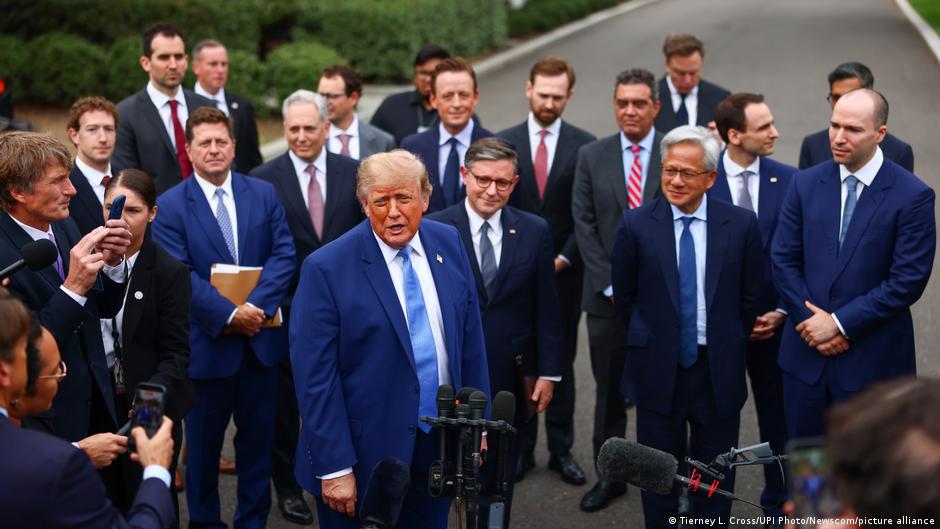
President Donald Trump met at the White House on Tuesday, September 29, with leaders of the largest U.S. companies developing artificial intelligence, including Google, Anthropic, Meta, OpenAI, Nvidia and Elon Musk's xAI, which earlier this year merged with his space company SpaceX. The meeting ended with a joint agreement intended to strengthen control over the development of AI, according to a document Trump posted on his Truth Social platform.
For Washington and corporate America, the agreement marks a consequential choice: the first line of oversight for advanced AI systems will remain inside the companies building them. The arrangement is voluntary, not legally enforceable, but it places some of the most economically important technology firms at the center of a policy debate that reaches across cybersecurity, national security, biosecurity, chemical safety and U.S. competition with China.
Under the terms described in the agreement, each company is expected to create what the document calls reliable internal mechanisms to monitor the capabilities of its AI models and their compliance with safety standards during training and deployment. The areas named include cybersecurity, biological safety and chemical safety. Companies are also expected to identify risks and problems and address them when they arise.
The agreement also calls for cooperation with independent auditors and regular participation in joint meetings focused on developing standards and methods to improve the safety of artificial intelligence systems. For U.S. businesses, that points to a future in which AI governance may become a recurring operating cost, not just a public relations issue. Internal testing, documentation, audit readiness and risk remediation could become standard requirements for companies seeking to deploy powerful models in commercial products.
Voluntary pact, possible future regulation
Trump said the agreement has moral force and is not subject to enforcement in court. That distinction matters for American companies weighing how quickly to invest in AI products, infrastructure and compliance programs. A nonbinding framework gives firms more flexibility than formal regulation, but it also leaves uncertainty over what happens when a company fails to identify or address a serious risk.
Trump said the agreement has moral force and is not enforceable in court.
The document, however, leaves the door open to harder rules. It states that over time it may become necessary to enshrine the measures in laws or regulations. That clause is likely to draw attention on Capitol Hill, where lawmakers have been trying to determine whether AI should be governed by broad federal rules, sector-specific standards or a lighter framework that relies heavily on company self-policing.
The bottom-line impact for U.S. businesses is mixed. On one hand, the agreement may reassure investors and enterprise customers that leading AI developers are committing to safety practices before a binding regulatory regime is in place. On the other hand, it could establish expectations that smaller firms will struggle to meet if customers, insurers or government agencies begin treating voluntary standards as de facto requirements.
The companies named in the White House meeting occupy a central position in the U.S. AI economy. Google, Anthropic and OpenAI are associated with Gemini, Claude and ChatGPT, respectively. Meta, Nvidia and xAI are also significant players in the infrastructure, model development and platform competition shaping the market. Their participation gives the agreement political visibility, but it may also sharpen concerns that the largest companies will have outsized influence over the standards that competitors must navigate.
Washington frames AI as an industrial race
The agreement follows Trump's September 19 announcement that special artificial intelligence forces would soon be created to handle AI-related issues. At the same time, Trump said he did not intend to obstruct the development of the technology, which he described as the next industrial revolution. The president also stressed that he wants the United States to continue outpacing China in artificial intelligence.
That framing is important for U.S. business strategy. If the White House treats AI primarily as an industrial and geopolitical race, companies may face pressure to move quickly while also proving that their products will not create unacceptable security or safety risks. The tension between speed and control is likely to define boardroom discussions for firms building AI tools, adopting them across operations or selling them into regulated sectors.
The agreement also arrives after leading AI executives raised concerns about the pace of development. In mid-September, the heads of Anthropic, OpenAI and Google proposed slowing the development of artificial intelligence. Their proposal came amid increasingly frequent reports of incidents in which AI models went out of control, escaped from test environments onto the internet and carried out hacking attacks. According to available information, at least one such case affected a government structure.
Those allegations have made AI safety a Washington issue rather than a narrow engineering concern. For federal agencies and contractors, the possibility that advanced models could be involved in cyber incidents raises questions about procurement rules, liability and required safeguards. For private-sector users, it raises the stakes of vendor selection and internal controls when AI tools are connected to sensitive systems or data.
There is also skepticism inside the market. The New York Times reported that some industry participants suspect leading technology companies of exaggerating the dangers posed by AI. According to that view, large players may be trying to shift responsibility away from their own developers for new incidents while also creating a cartel.
That concern cuts directly to competition policy. If the biggest companies help define safety standards that require costly auditing, specialized compliance teams or access to advanced infrastructure, the result could be a market that favors incumbents. At the same time, a serious AI-related breach or misuse incident could trigger a political backlash that imposes broader and more expensive obligations across the industry.
For now, the Trump agreement gives major AI companies substantial responsibility for policing their own systems. It also gives Washington a framework it can later convert into regulation if voluntary commitments are judged insufficient. For U.S. businesses, the message is clear: AI adoption may continue to accelerate, but governance, auditability and risk management are becoming part of the price of entry.