Ukraine Sanctions Organizers of Russian Duma Voting in Occupied Regions
Kyiv’s move adds pressure on Moscow’s political project in occupied Ukraine as Washington and US companies track sanctions exposure.
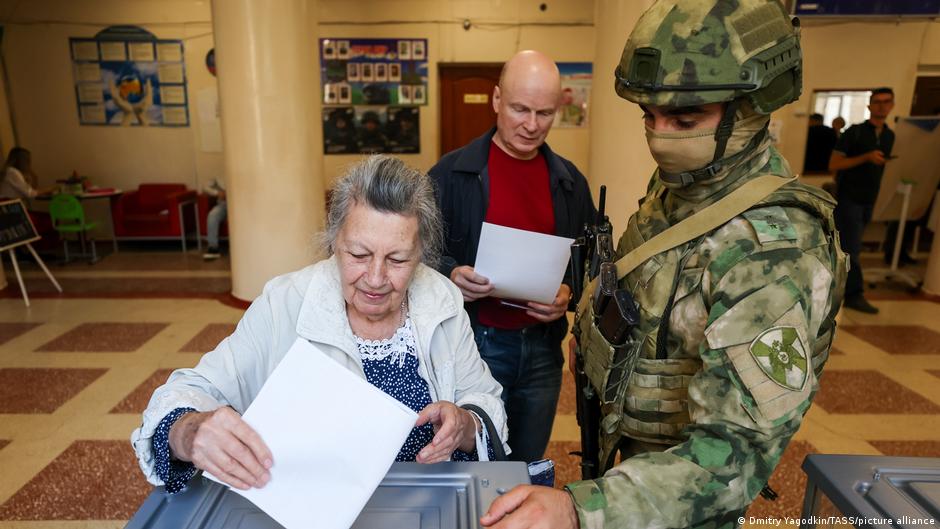
Ukrainian President Volodymyr Zelensky has imposed sanctions on people involved in organizing Russian State Duma elections in occupied Ukrainian territories, expanding Kyiv’s effort to challenge Moscow’s political control over areas seized during the war and to align enforcement pressure with Western partners.
The sanctions, introduced on Saturday, September 27, target 44 people connected to the conduct of the Russian parliamentary vote in occupied areas. According to the Ukrainian president’s office, 38 of those sanctioned hold both Ukrainian and Russian citizenship. Ukrainian officials said some of the individuals had already been “elected” as so-called deputies of illegally formed local councils on temporarily occupied Ukrainian territory.
For Washington, the action is another marker in the sanctions architecture surrounding Russia’s war against Ukraine. While the measures were adopted by Kyiv, they come after the European Union signaled readiness to add people involved in the voting process to its own sanctions lists. That raises the likelihood of wider restrictions affecting travel, assets, banking access and business dealings for individuals linked to the political administration of occupied Ukrainian regions.
Russian Vote Draws Western Rejection
Russia held State Duma elections from September 18 to September 20. For the first time in parliamentary elections, Russian authorities organized voting in occupied territories of Ukraine’s Kherson, Zaporizhzhia, Donetsk and Luhansk regions. Ukraine and its Western allies rejected both the process and the results as illegal.
The European Union also said it was prepared to impose sanctions on people who helped conduct the elections in occupied Ukrainian territories. That statement matters for American businesses because EU designations can complicate compliance reviews for multinational companies operating across both US and European jurisdictions, even before Washington takes parallel action.
Ukraine and its Western allies recognized the voting process and its results as illegal.
The United States was not named in the Ukrainian announcement described in the source material, but the issue fits squarely into a policy area closely watched in Washington: the use of sanctions to deny legitimacy and resources to Russian control structures in occupied Ukraine. For American companies, the immediate bottom-line concern is not the local vote itself, but the broader sanctions risk attached to any counterparties, intermediaries or politically exposed individuals connected to Russian-installed administrations.
Occupied Regions Given Duma Districts
For the 2026 State Duma elections, Russian authorities for the first time created separate single-mandate districts for Ukrainian regions occupied after 2022. The move was part of Moscow’s effort to fold occupied areas into Russia’s formal political system, despite Ukraine’s position that those territories remain under illegal occupation.
According to the announced Russian results, several candidates were declared elected in single-mandate districts in the occupied territories. In the so-called Donetsk People’s Republic, Russia named First Channel war correspondent Irina Kuksenkova and Alexander Borodai, a former “head” of the self-proclaimed republic, as elected. In the so-called Luhansk People’s Republic, Denis Kolesnikov and Ivan Sanayev, described as “local parliament deputies,” were declared elected.
In occupied parts of Zaporizhzhia region, Russia announced Alexei Tikhomirov as elected. In Kherson region, it named Elena Dmitruk, described as a “deputy chair” of the local parliament. All of these candidates were nominated by United Russia, the ruling party aligned with the Kremlin.
In addition to the single-mandate winners, eight more representatives of the “authorities” in occupied Ukrainian territories entered the Russian State Duma through federal party lists. Among them was Serhiy Arbuzov, a former first deputy prime minister of Ukraine under President Viktor Yanukovych and former head of the National Bank of Ukraine. He was nominated by the party A Just Russia.
Compliance Risk for US Firms
The sanctions announced by Zelensky do not automatically create US legal restrictions. But they add another layer of political and compliance risk around individuals and entities tied to Russian activity in occupied Ukrainian territories. US companies with global exposure, particularly in finance, logistics, technology, insurance, commodities and professional services, typically monitor Ukrainian, EU, UK and US sanctions actions together because restrictions often move in parallel over time.
For banks and other financial institutions, dual Ukrainian-Russian citizenship among sanctioned individuals may also complicate screening. Names associated with occupied administrations, local councils, party lists or regional election structures can appear in corporate records, property documentation, media reports or transaction chains. Even where no US designation exists, firms may decide that the reputational and regulatory risks are too high to proceed.
The political signal is equally important. Kyiv is seeking to document and penalize participation in Russian governance structures in occupied areas, while Western allies have said they do not recognize the legitimacy of the votes. That position reinforces a sanctions strategy aimed not only at military supply chains but also at the civilian and political machinery Moscow uses to normalize control.
For policymakers in Washington, the Ukrainian action may provide a roadmap for additional targeting if the United States chooses to coordinate with Kyiv and Brussels. For businesses, the message is more immediate: counterparties connected to Russia’s administration of occupied Ukrainian territory remain a high-risk category, and the list of individuals facing restrictions is likely to remain dynamic as governments respond to Moscow’s attempts to formalize political control.