Georgia Opposition Launches New Protest Wave as Party Ban Case Looms
The unrest raises fresh concerns in Washington over Georgia’s democratic trajectory and the operating climate for U.S. businesses.
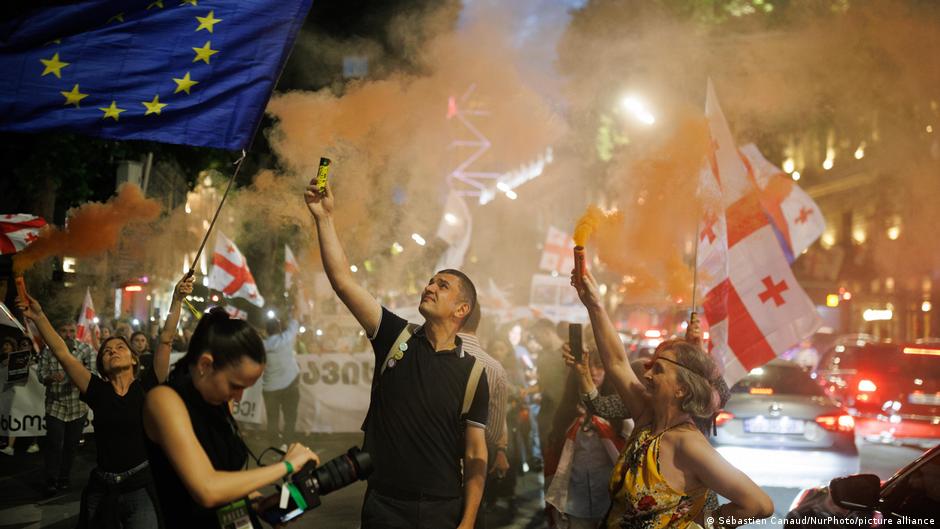
Georgia’s opposition leaders have declared the start of a new wave of protests against the policies of the ruling Georgian Dream party, as the country’s Constitutional Court considers a lawsuit seeking to ban opposition parties.
Thousands of people joined a protest march in the capital, Tbilisi, on Sunday, October 25, under the slogan “Georgia Without Ivanishvili.” The demonstration was organized by opposition representatives and civil society groups amid mounting concern over restrictions on political competition.
Participants marched from Tbilisi State University toward Rustaveli Avenue, a central thoroughfare that has repeatedly served as a focal point for political demonstrations. Protesters carried the flags of Georgia, Ukraine and the European Union. A large contingent of security personnel was also present.
For Washington, the renewed mobilization puts the political direction of a strategically located partner back under scrutiny. Georgia has long occupied an important position between Europe, Russia, Turkey and the wider Caspian region. A prolonged political confrontation could complicate U.S. engagement with the country and add uncertainty for American companies assessing investments, contracts or regional operations there.
Opposition Plans Major November 28 Rally
Nika Gvaramia, leader of the Coalition for Change, described Sunday’s rally as the opening stage of a new protest campaign. Opposition organizers are seeking a large turnout on November 28, the second anniversary of the start of Georgia’s mass protests, while leaving open the possibility that the movement could continue in the following days.
“We are starting today, and we definitely need a culmination, whether it is November 28 or in the following days. It is important that there are very many of us on the 28th, so that the wind cannot extinguish the fire,” Gvaramia said before the rally.
Gigi Tsereteli, the leader of European Georgia, also attended the march and said a major demonstration was planned for November 28. He presented the dispute as a sharp reversal for a country once viewed as a leading candidate for closer European integration.
“What is happening in Georgia today in terms of the destruction of democracy and disruption is truly unimaginable, given that we were a champion country on the path of European integration and today we are outsiders,” Tsereteli said.
He added that parties were being banned and political life was effectively being restricted, while pointing to political prisoners as another major challenge. The Constitutional Court’s consideration of the lawsuit to prohibit opposition parties has therefore become a central issue for protesters and a test of how much room will remain for organized political dissent.
Political Risk Extends Beyond Tbilisi
The latest march follows more than two years of escalating tension. Mass protests began in spring 2024 over Georgia’s “foreign agents” law. The unrest intensified after Georgian Dream won parliamentary elections and developed into a broader political crisis in November 2024, when the authorities decided to postpone negotiations on joining the European Union until 2028.
Previous demonstrations included clashes with police. Security forces dispersed protesters with tear gas and water cannons, establishing a record of confrontation that will shape expectations ahead of the planned November 28 rally.
The bottom-line issue for U.S. businesses is predictability. Renewed street protests, the possibility of opposition parties being prohibited and the prospect of another forceful police response can increase political and operational risk. Companies with employees, suppliers or commercial partners in Georgia may need to monitor transportation disruptions, security conditions and changes to the legal and regulatory environment as the court case and protest campaign advance.
The dispute also has implications for American companies using Georgia as a link to markets and transport routes across the South Caucasus. Political instability does not automatically halt commerce, but sustained demonstrations and institutional conflict can delay decisions and raise compliance, security and contingency-planning costs.
For U.S. policymakers, the challenge is broader than a single march. The flags displayed by protesters underscored their identification with Ukraine and the European Union, while opposition leaders portrayed Georgian Dream’s policies as a retreat from democratic norms and European integration. Washington will have to weigh those concerns against the need to maintain engagement in a region exposed to intense geopolitical competition.
The immediate focus will be the Constitutional Court proceedings and the opposition’s ability to mobilize a substantially larger crowd on November 28. The conduct of Georgian authorities and security forces will also be closely watched. Together, those developments will indicate whether the new protest wave remains a series of demonstrations or becomes another prolonged national crisis with wider consequences for Georgia’s international relationships and business environment.