Pussy Riot and Femen Protest at Russian Pavilion in Venice Biennale Amid Ukraine War Tensions
Activists demand Russia’s representation by political prisoners with pro-Ukrainian views, highlighting human rights concerns amid ongoing conflict.
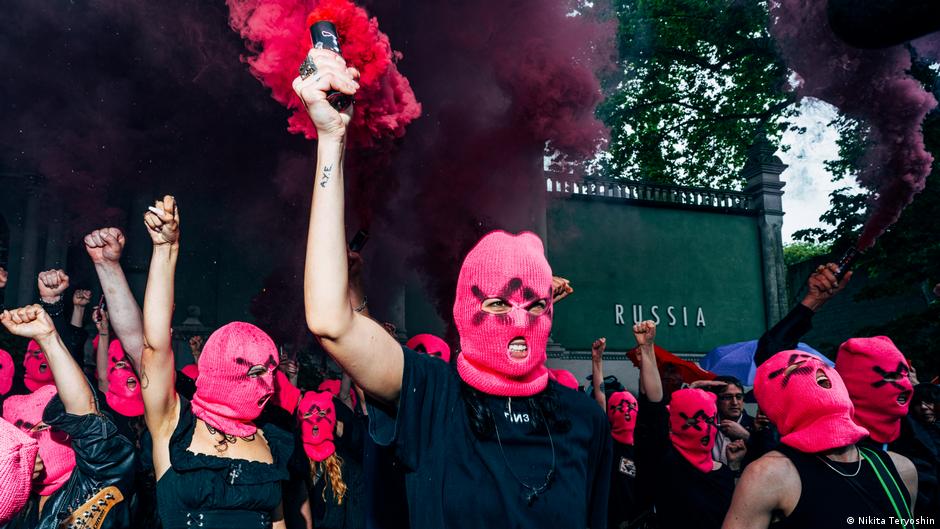
On May 6, feminist punk group Pussy Riot and the Ukrainian women’s movement Femen staged a protest outside the Russian pavilion at the Venice Biennale. Their demonstration called for Russia to be represented by political prisoners holding pro-Ukrainian views, rather than official state-sanctioned artists.
The activists ignited pink, yellow, and blue smoke flares—the colors of the Ukrainian flag—and chanted slogans including "Russian art is blood." Signs bore messages such as "Enjoy the show—ignore the war," "Curated by Putin, corpses included," and "Art on display, graves below." Some protesters painted these slogans on their bodies, and Ukrainian flags and masks were draped over statues near the pavilion.
Political and Business Implications for Washington and US Interests
“The best Russian citizens are either imprisoned or killed for anti-regime and pro-Ukrainian actions, while Europe opens doors to Putin’s officials and propagandists,” said Pussy Riot member Nadezhda Tolokonnikova.
Russia’s participation in the Venice Biennale marks its first appearance since its full-scale invasion of Ukraine began. The decision by organizers to allow the Russian pavilion has sparked sharp criticism from the European Union and Ukraine. The European Commission has asserted that Russia’s inclusion violates EU sanctions legislation.
Organizers limited access to the Russian pavilion to invited guests only from May 6 to May 8, during which a continuous sound performance titled "Tree Rooted in the Sky" is held. Starting May 9, when the Biennale opens to the public, the pavilion will be closed. In response to the controversy surrounding both the Russian and Israeli pavilions, the Biennale jury excluded Russia and Israel from award considerations and subsequently resigned en masse.
From a Washington perspective, this situation underscores the complex challenges American businesses and policymakers face when navigating cultural diplomacy intertwined with geopolitical conflicts. US companies involved in the global art market and cultural sectors must weigh reputational risks linked to Russia’s presence in international events amid ongoing sanctions and political pressure.
The Russian pavilion is managed by Smart Art, a company founded by Ekaterina Vinokurova and Anastasia Karneeva. Karneeva is the daughter of a retired general and deputy director of Rostec, Russia’s state defense conglomerate, while Vinokurova is the daughter of Russian Foreign Minister Sergey Lavrov. This direct connection to Russia’s political and military elite intensifies scrutiny and potential ramifications for any Western business affiliations.
For Washington policymakers, the Venice Biennale episode reflects the broader struggle of balancing engagement with Russia’s cultural institutions against the imperative to uphold sanctions and support Ukraine. It also signals potential diplomatic tensions in cultural exchanges, which may spill over into economic and political domains affecting US-Russia relations and multilateral cooperation.
In summary, the protest by Pussy Riot and Femen at the Russian pavilion highlights persistent human rights abuses and the contested nature of Russia’s international representation during wartime. For American businesses and policymakers, it serves as a cautionary tale on the impact of geopolitical conflicts on cultural diplomacy and the bottom-line considerations in global markets.