Serbia’s Election Showdown Raises Stakes for Washington and US Business
A 150,000-strong opposition rally signals a close Serbian election with implications for US diplomacy and corporate risk planning.
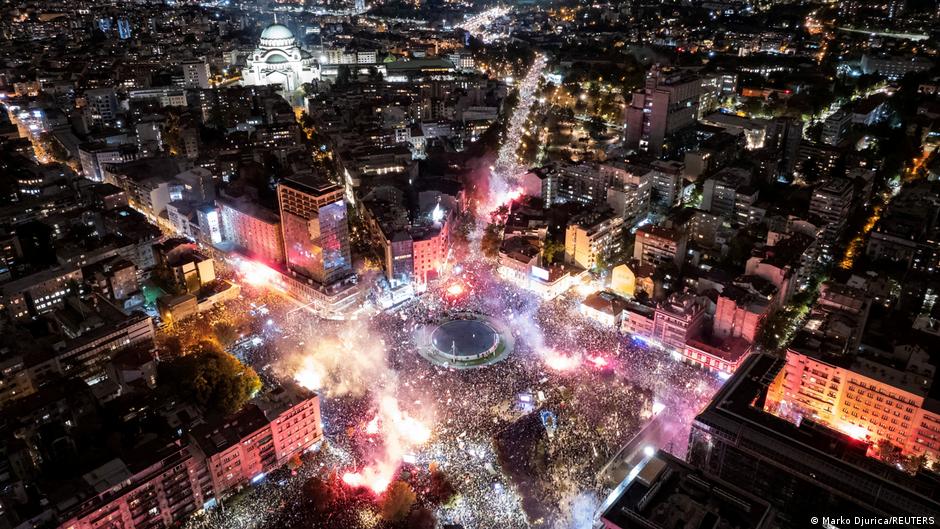
About 150,000 people rallied in Belgrade ahead of Serbia’s snap parliamentary election, according to organizers, underscoring the scale of the political challenge facing President Aleksandar Vučić and his governing Serbian Progressive Party.
The demonstration took place in the Serbian capital on Thursday, October 22, before the October 25 vote. Opposition supporters called for an end to Vučić’s rule and urged voters to back the “Student List,” a movement that grew out of nearly two years of student-led protests and has become a significant political force.
For Washington, the election represents more than a domestic contest in a Balkan country. Serbia’s political direction matters to US policymakers seeking stability in southeastern Europe, while the prospect of a change in government introduces questions for American companies assessing political continuity, regulatory conditions and longer-term investment risk.
A Student Movement Challenges the Governing Party
The snap election followed sustained protests triggered by the November 2024 collapse of a canopy at the railway station in Novi Sad. The station had been renovated shortly before the disaster, which killed 16 people. Serbian independent media and opposition groups identified corruption as one of the principal causes of the tragedy.
Students became the main driving force behind the demonstrations that followed. Their movement ultimately produced the Student List, an unconventional electoral organization without a clear leader. Its candidates will not include professional politicians. Instead, students want academics, activists and public figures to represent the movement.
Students have sought to turn a protest movement born from the Novi Sad tragedy into an electoral challenge to Serbia’s entrenched governing establishment.
That approach may prove competitive. A survey by the New Serbian Political Thought project, published October 20, showed the Student List with support from 44.5% of respondents, compared with 42.7% for Vučić’s Serbian Progressive Party. An equivalent poll at the beginning of October put the Student List at 44.4% and the governing party at 41.7%.
The figures suggest a close race and indicate that Vučić’s party could face a serious erosion of its political position. Most Serbian opposition parties have withdrawn from the contest and called on their voters to support the students, further concentrating the anti-government vote behind the new movement.
Vučić Seeks a More Powerful Office
One of the students’ central demands since the protests began in 2024 has been Vučić’s resignation. Although he has repeatedly said he would take that step, he effectively plans to seek a change of office rather than leave power. On October 25, he will compete for the post of prime minister.
A victory for the Serbian Progressive Party would therefore allow Vučić to remain in control. Under Serbia’s Constitution, the prime minister holds broader powers than the president, although Vučić became the most prominent figure in the country’s governing establishment during his presidency.
Vučić previously served as prime minister from 2014 to 2017, leaving the position after winning the presidential election. Representatives of his party have continuously held the premiership since then. His proposed return to the office would preserve the central role he has played in Serbian politics since 2014 while placing him in a constitutionally stronger post.
Washington and Corporate Risk
The immediate US concern is whether the election produces a clear and broadly accepted outcome. A narrow result between the Student List and the governing party could prolong political uncertainty, particularly after almost two years of street protests. The size of the Belgrade rally demonstrates that opposition to Vučić is organized and capable of mobilizing large numbers of people.
For American businesses, the bottom-line issue is predictability. A continuation of Serbian Progressive Party rule would preserve an established governing structure, but it would not necessarily end the protests or the underlying dispute over corruption and accountability. A Student List victory, meanwhile, would bring a political movement with no obvious leader and no professional politicians among its candidates into a position of national responsibility.
Neither outcome automatically determines commercial policy, and the source polling does not establish the final result. Still, US companies with operations, suppliers or prospective investments in Serbia will need to monitor government formation, administrative continuity and any changes in the country’s political environment after the vote.
The election will also test whether a decentralized protest campaign can convert public anger into governing authority. With the opposition largely consolidating behind the students and polling showing only a narrow separation between the two leading forces, the October 25 vote could reshape Serbia’s political landscape—or return Vučić to power in a stronger constitutional office.