German Protests Against Far-Right AfD Signal New Pressure Point for Washington
Demonstrations across more than 35 German cities underscored political strains in Europe’s largest economy after AfD’s regional election win.
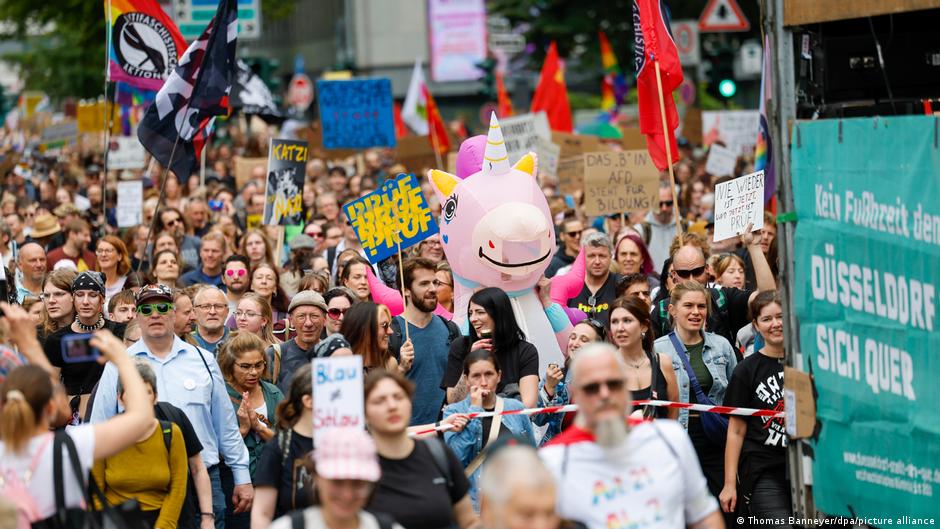
Mass demonstrations against right-wing extremism took place in more than 35 German cities on Saturday, September 12, adding a fresh political signal from Europe’s largest economy at a moment closely watched in Washington and by U.S. companies with deep exposure to the German market.
Tens of thousands of people joined the protests, which were organized by more than 100 groups. The demonstrations came one week after the far-right Alternative for Germany, or AfD, won state elections in Saxony-Anhalt, a result that has intensified scrutiny of Germany’s domestic political trajectory and the durability of the country’s long-standing barriers against cooperation with the far right.
In Hamburg, organizers estimated that 25,000 people took part. In Düsseldorf, the turnout was estimated at about 20,000, a figure also confirmed by local police. In Berlin, law enforcement authorities estimated that 18,000 people joined the protest, while around 12,000 people participated in Munich, according to the public broadcaster ARD. About 2,000 people demonstrated in Mainz.
The protests also reached several regional capitals where the AfD’s strength has become a defining political issue. In Magdeburg, the capital of Saxony-Anhalt, about 1,100 people joined the demonstration. In Saarbrücken, around 1,500 people took part. Several hundred demonstrated in Erfurt. In Schwerin, the capital of Mecklenburg-Western Pomerania, several dozen people gathered one week before local elections in a state where polls also show the AfD in the lead.
Why Washington and U.S. Business Are Watching
For U.S. policymakers, the demonstrations highlight a larger question: how Germany’s political center responds to the rise of a party that Germany’s domestic intelligence agency has assessed as tied to right-wing extremism. Germany is a central U.S. ally, a key NATO member, and a major destination for American corporate investment. Domestic instability or a sharper political turn in Berlin and the German states can therefore carry implications beyond German electoral politics.
The source article does not specify the AfD’s policy positions toward the United States, American companies, NATO, trade, or investment. Still, the scale and geographic spread of the protests underline a broader business and diplomatic reality: Germany’s political climate is becoming a more important risk factor for companies and governments that depend on predictable German institutions, regulatory continuity, and stable transatlantic coordination.
The demonstrations were not only a reaction to an election result. In several cities, including Munich, Mainz, Saarbrücken, and Magdeburg, they were held as part of the Prüf campaign, which is pressing for close examination of parties classified by Germany’s Federal Office for the Protection of the Constitution, known as the BfV, as either “suspected” of right-wing extremism or “definitely right-wing extremist.”
Prüf translates from German as “check,” and organizers present it as an acronym for Prüfung Rettet Übrigens Freiheit, meaning “Checking, by the way, saves freedom.”
That framing matters for a U.S. audience because the dispute is moving beyond street politics into questions of state authority, party regulation, constitutional protection, and legal process. Germany’s ability to manage those questions within its democratic institutions is central to how allies and investors assess the country’s political resilience.
Calls for an AfD Ban Procedure
At the demonstrations, participants demanded the launch of a procedure to ban the AfD. In May 2025, the BfV classified the party as right-wing extremist at the federal level. However, that classification is not yet in effect because of a lawsuit filed by the party.
The slogans used in major cities reflected the urgency among protest organizers and participants. In Düsseldorf, demonstrations took place under the slogan “Kein Schritt zurück! Gegen die AfD und rechte Hetze!” which translates as “Not one step back! Against the AfD and right-wing incitement.” In Hamburg, the slogan was “Zeit zum Handeln - Freiheit muss verteidigt werden,” or “Time to act - freedom must be defended.”
The demand for a ban procedure raises a difficult political calculation. Any move against a party with significant electoral support would likely face close legal scrutiny and could reshape the debate over democratic safeguards in Germany. For Washington, that debate is consequential because it concerns the internal stability of a leading partner at a time when U.S. and European governments are managing security, industrial, and economic pressures across the Atlantic.
For U.S. businesses, the bottom-line issue is not merely whether protests occur, but whether Germany remains a predictable environment for investment, hiring, supply chains, manufacturing, and compliance planning. The article does not report any immediate disruption to American firms or German business operations from the demonstrations. But the political backdrop is relevant to boardrooms because Germany remains a critical European market, and regional election outcomes can influence policy expectations, coalition dynamics, and local governance.
German Opinion Remains Split
A poll by the INSA public opinion research institute, conducted on September 10 and 11, showed that 42% of respondents supported the idea of banning the AfD, while 45% opposed it. The same survey found that nearly half of Germans, 46%, opposed the policy known as a “firewall” toward the AfD, which means refusing to cooperate with the party. Thirty-four percent supported maintaining the barrier, while 20% were undecided.
Those figures point to a politically divided country. The demonstrations showed substantial mobilization against right-wing extremism, but the polling suggests that public views on how to respond to the AfD are far from settled. The split over a potential ban and the firewall policy creates uncertainty for Germany’s political establishment as it attempts to contain the party’s rise without deepening polarization.
For American observers, the weekend protests are therefore part of a larger strategic picture. Germany’s domestic politics are increasingly tied to questions that matter in Washington: the strength of democratic institutions, the reliability of allied governments, and the operating environment for U.S. businesses in Europe. The demonstrations across Germany did not resolve those questions, but they made clear that the political battle over the AfD is now being fought simultaneously in elections, courts, intelligence classifications, opinion polls, and the streets.