Russian Ballistic Missile Strikes in Kyiv Injure Six Amid Rising Civilian Casualties
Nighttime missile attacks on Kyiv highlight escalating conflict and growing impacts on Ukrainian civilian infrastructure and populations.
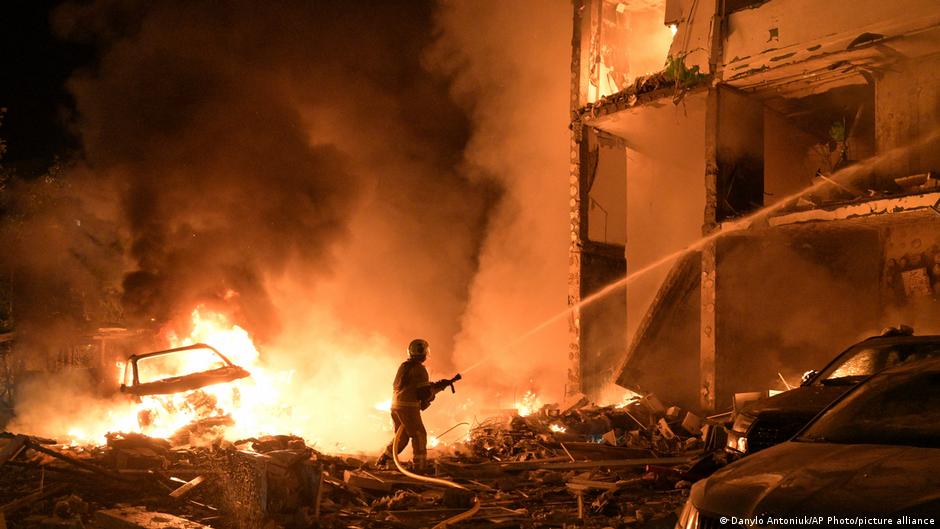
At least six people were injured in Kyiv following a series of ballistic missile strikes carried out by Russian forces overnight into July 10, according to local authorities. The attacks targeted multiple locations in the Ukrainian capital without prior air raid warnings, intensifying concerns over civilian safety as the conflict endures.
Kyiv Mayor Vitali Klitschko confirmed the use of ballistic missiles in the strikes, which began around 3:38 a.m. local time. Alarmingly, air raid sirens were activated only minutes later: in Kyiv city at 3:40 a.m., and in the surrounding Kyiv region at 3:54 a.m., leaving residents exposed during the initial attacks.
Damage and Casualties in Kyiv
The missile impacts caused fires at a transformer substation in the Darnytskyi district and an office building in the Solomianskyi district. Additional damage was reported in the Sviatoshynskyi district where a missile hit a non-residential building, while the Dnipro district experienced a fire at another non-residential site.
Of the six injured, three were treated on site while the others required hospitalization, Mayor Klitschko stated. This latest strike compounds a devastating trend in civilian harm tied to the ongoing conflict.
“The most lethal months for civilians since the full-scale invasion began were May and June 2026, with casualties continuing to rise,” said a United Nations official.
The United Nations has documented a severe increase in civilian casualties over recent months. In May 2026 alone, 274 civilian deaths were recorded in attacks attributed to Russian forces, with 265 deaths and 1,816 injuries recorded in June. Early July figures indicate at least 93 civilian fatalities in the first week alone. These figures underscore a troubling upward trend during typically lethal spring and summer periods.
Meanwhile, Ukraine has escalated its own strategic strikes, particularly focusing on Russian oil refineries using drone attacks. President Volodymyr Zelensky has described these operations as “long-range sanctions” aimed at undermining Russia’s energy capabilities and pressuring Moscow toward peace negotiations.
"These strikes have exacerbated the gasoline crisis in Russia, impacting not only public sentiment but also within President Putin's inner circle," Zelensky noted in a video address on July 10. He further announced the establishment of a special command within Ukraine’s armed forces dedicated to continuing these targeted operations.
Despite Russia’s worsening internal situation, Kremlin sources cited by Reuters indicate President Vladimir Putin remains committed to an uncompromising stance, aiming for complete control over the Donbass region and further escalation in the conflict.
For U.S. policymakers and American businesses, the intensifying conflict and associated sanctions bear significant implications. Heightened instability in Ukraine risks disrupting energy markets, with potential ripple effects on global oil prices and supply chains. U.S. companies operating internationally must monitor evolving geopolitical risks, while policymakers weigh support measures for Ukraine alongside sanctions targeting Russia’s energy sector.