Putin Tells Armenia EU Bid Would Mean Leaving Eurasian Economic Union
The Russian leader warned that Armenia cannot pursue EU accession while remaining in Moscow’s trade bloc, sharpening a dispute with regional and business implications.
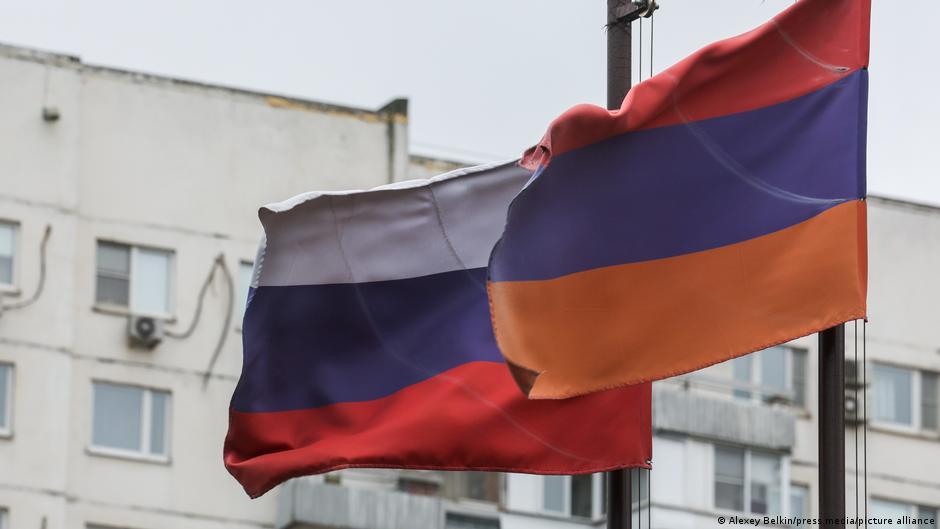
Russian President Vladimir Putin told Armenian Prime Minister Nikol Pashinyan that Armenia’s move to begin the process of joining the European Union would, in practice, amount to leaving the Eurasian Economic Union, according to a Kremlin transcript published on Tuesday, September 1. The exchange puts fresh pressure on Yerevan’s balancing act between deeper ties with Europe and its existing economic commitments to a Russia-led bloc.
Putin and Pashinyan met on the sidelines of the Shanghai Cooperation Organization summit in Bishkek. The central issue in the talks was Yerevan’s plan to submit an application for EU membership, a step Pashinyan publicly signaled on August 24.
Putin said Armenia could not remain in both frameworks at once.
“You said that you had not declared your withdrawal. The adoption of a law on starting the procedure of joining another economic organization in fact means a statement of withdrawal from ours, because being there and there is incompatible. That is the problem,”Putin said, referring to the EU as the “other organization” and the Eurasian Economic Union, or EAEU, as “ours.”
The Russian president again urged Armenia to hold a referendum on whether to align with the EU or remain in the EAEU, saying the issue should be put directly to the public.
Pashinyan rejected the argument that Armenia had breached any legal obligations. He said Yerevan had analyzed the treaty framework governing relations between Russia and Armenia, as well as the agreements that operate inside the EAEU, and had found no violations of Armenia’s commitments to either Russia or the bloc. Pashinyan also said that with the adoption in 2025 of a law on European integration, Armenia had effectively moved away from the idea of holding a referendum on a choice between the EU and the EAEU.
Pressure point for Washington and business
For Washington, the dispute underscores a broader geopolitical contest over the South Caucasus, where Russia is trying to preserve economic influence as Armenia signals a westward turn. For U.S. policymakers, the case is likely to be watched less as a technical question of treaty law than as a measure of how far Moscow is prepared to go in using trade and market access as leverage against a neighboring state seeking closer ties with Europe.
That matters for U.S. businesses because Armenia’s strategic direction can affect trade routes, sanctions risk, regional supply chains and the operating climate for companies with exposure to the Caucasus and broader post-Soviet markets. Any forced decoupling from the EAEU would raise questions about customs arrangements, regulatory alignment and market access across a bloc designed to facilitate commerce among member states.
The European Commission, responding after Pashinyan’s August 24 statement, said Armenia is now “closer to the European Union than ever before.” At the same time, Brussels stressed that accession takes place through a “clearly defined process based on merit.” That response leaves Armenia with a political opening toward Europe but no immediate fast track, increasing the importance of how Yerevan manages the economic and diplomatic fallout with Moscow in the interim.
Pashinyan had already said in June that there were no grounds to hold a referendum on joining the European Union. He made that statement in response to a joint declaration by the leaders of Russia, Belarus, Kazakhstan and Kyrgyzstan. Putin had previously argued that EU membership and EAEU membership cannot be combined. He also said that the so-called “Ukrainian scenario” began with Kyiv’s attempt to join the EU.
Those remarks are likely to resonate in Washington, where officials and analysts have long viewed Russian references to Ukraine as signals not only of historical grievance but of current red lines. In this case, Moscow is framing Armenia’s European course as incompatible with participation in its own economic sphere, a formulation that could shape future U.S. assessments of regional stability and coercive economic statecraft.
The pressure on Armenia intensified before the country’s parliamentary elections on June 7. Moscow stepped up pressure on Yerevan, including by banning the import of certain Armenian products into Russia. The election was ultimately won by Pashinyan’s Civil Contract party. Pashinyan and Putin then met in person in Bishkek on September 1 for the first time since that vote.
That sequence is important for U.S. business readers because it highlights the way political disputes in the region can quickly spill into trade restrictions. Russia’s earlier ban on some Armenian products demonstrated how market access can become a tool of political pressure. For exporters, logistics firms and investors, the lesson is straightforward: geopolitical risk in the Caucasus is not abstract. It can translate into concrete barriers affecting goods, pricing and contract planning.
What comes next depends on whether Armenia proceeds from political signaling to a formal EU accession track, and on whether Russia chooses further economic pressure in response. Yerevan is maintaining that it has not violated its obligations and is not formally withdrawing from the EAEU simply by launching the process toward Europe. Moscow is arguing the opposite, saying the two paths are incompatible by definition.
For the United States, the immediate implications are diplomatic rather than commercial on a large scale, but the broader pattern is familiar. A small state on Russia’s periphery is testing whether it can pivot toward Western institutions without absorbing major economic costs. The answer will matter not only for Armenia’s future trade alignment, but also for how American officials and companies judge political risk in a region where access, alliances and commerce remain tightly intertwined.