Uzbekistan's First ID Card Fee Draws Scrutiny as Region Lowers Costs
A social media account of a father struggling to pay for his daughter's first document has sharpened debate over fees, fairness and regional policy.
The fee charged in Uzbekistan for a citizen's first ID card has moved to the center of a public debate after a social media post described a family struggling to pay for the document their teenage daughter needed for the first time. For a U.S. policy and business audience, the dispute is more than a localized argument over administrative charges. It highlights how governments in Central Asia balance budget collection, social equity and digital-service reform, all of which shape the operating climate that American companies and Washington officials watch when assessing the region.
The immediate spark was a post by journalist Dilnoza Qurbonova about a scene at a passport office involving a girl believed to be about 15 or 16 and her father. Qurbonova wrote that the parents' worn clothing and faces reflected the weight of hard living and daily worries. When the cashier announced the sum required for the girl's first identity document, she wrote, the father's hands began to tremble as he opened his wallet and counted his cash one note and coin at a time, while the girl looked first at him and then at the ground.
He opened his wallet and began counting even his last small coins one by one. Seeing the father's anguish in those seconds, and the daughter's gaze shifting first to her father and then to the ground, broke my heart.
That account pushed a broader question into public view: how fair is the state duty charged for the first identity document in a child's life, and how does Uzbekistan compare with nearby countries? From a U.S. business and political perspective, the issue matters because the cost of first-time identification is a simple test of how a state balances revenue collection, social equity and administrative access. In that sense, the debate is not only about one payment at a cashier's window, but about the price of entry into formal civic and economic life.
How Uzbekistan's fee works
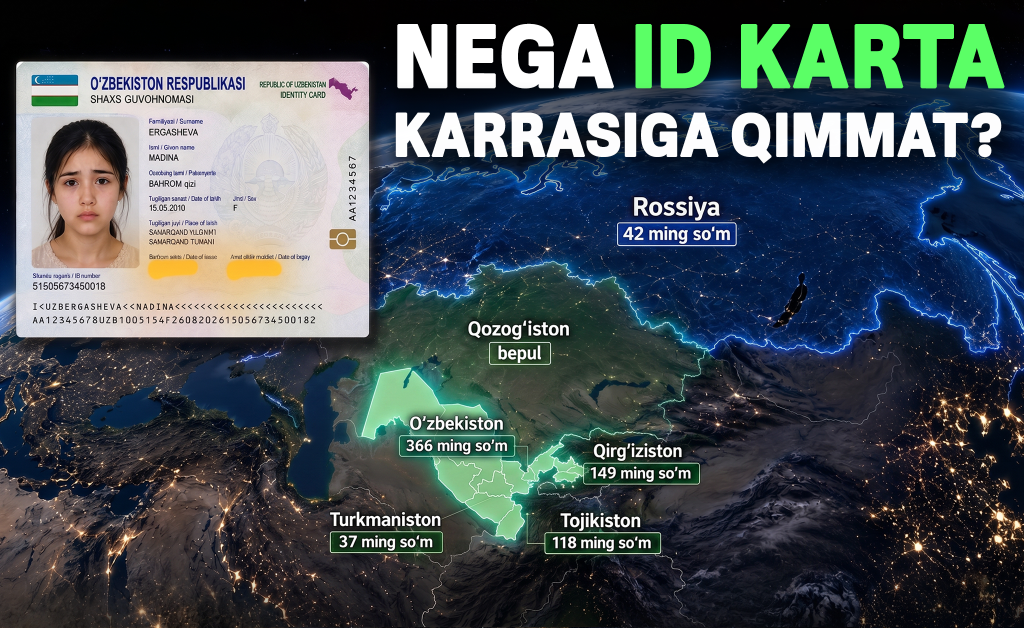
In Uzbekistan, the state duty for a first ID card varies depending on how the application is filed. If the application is submitted through a migration office, a public services center or a consulate, the fee is set at 89% of the base calculation amount, known locally as the BHM. Because the BHM currently stands at 412,000 soums, the charge comes to 366,680 soums. When the application is filed online through my.gov.uz, the payment is set at 80.1% of the BHM, meaning a current cost of 330,012 soums for a first ID card.
The underlying benchmark has already been lifted once and is scheduled to rise again. The BHM has been set at 412,000 soums since Aug. 1, 2025. From Sept. 1, 2026, it will increase to 440,000 soums. If the fee rates tied to the BHM remain unchanged, the state duty for first-time applications submitted through migration offices, public services centers or consulates will rise to 391,600 soums, while the online fee through my.gov.uz will increase to 352,440 soums. For households already under financial strain, the debate is therefore not static; it is tied to a benchmark about to move higher.
Regional comparison and policy signal
A comparison across eight states suggests Uzbekistan sits at the expensive end of the regional range for first-time identity documents. In Kazakhstan, every citizen turning 16 has been able to obtain an ID card free of charge for the first time since Jan. 1, 2026, and renewals after expiration are also free. First-time issuance after age 18, cases involving newly acquired Kazakh citizenship and certain other situations are also exempt from the state duty. The stated aim is to reduce citizens' financial burden and simplify documentation procedures.
Kyrgyzstan charges 1,103 Kyrgyz som for a first ID card under standard processing within 12 working days, equal at the quoted rate to about $12.6 or 149,000 Uzbek soums. That makes the ordinary Kyrgyz first-time document roughly 2.5 times cheaper than Uzbekistan's current 366,680-soum fee. In Tajikistan, the fee for issuing a citizen's ID card is set at $10, collected in somoni at the exchange rate on the day of payment, with processing taking up to 15 days. Based on the Central Bank of Uzbekistan's official exchange rate of Aug. 21, that is about 118,000 soums, or about 3.1 times cheaper than the Uzbek charge.
Turkmenistan does not have a separate national ID card, with the biometric passport serving as the main identity document. According to the State Migration Service, the state duty for a biometric passport is 60 manat. At black-market rates, that is about $3.2 or 37,000 Uzbek soums, and children under 16 are exempt from the fee, making the charge about 10 times lower than Uzbekistan's current first ID card duty. In Russia, citizens receive an internal passport at age 14, and the state duty for first-time issuance is 300 rubles, or about $3.6 and 42,000 Uzbek soums at the quoted rate. That is about 8.7 times cheaper than Uzbekistan's fee. Under Russia's Tax Code, the same 300-ruble charge applies to a first issuance and a standard replacement, while a lost or damaged passport costs 1,500 rubles.
Turkey's main identity document, the Turkiye Cumhuriyeti Kimlik Karti, is priced at 220 Turkish lira in 2026, or about $5 and 59,000 Uzbek soums. But if a child's birth is registered within the period required by law and the first identity card is issued on that basis, no fee is charged. A card issued after the deadline or because of replacement costs 220 lira. In Azerbaijan, identity cards are issued to citizens from age 15, and the Interior Ministry says the standard 10-day process carries a state duty of 5 manat.
For Washington and U.S. companies, the takeaway is not only that Uzbekistan's fee is higher than several neighbors' charges, but that the cost lands at the first formal point of entry into documented civic and economic life. That makes the issue politically sensitive and commercially relevant. A government that eases this kind of access lowers friction for future consumers, workers and service users; a government that keeps the price high risks reinforcing exclusion at the household level. As Uzbekistan continues to digitize services, the controversy around a first ID card fee has become a test of how far reform is meant to reach ordinary families.