White House Says U.S. Envoys Discussed Ukraine Peace Details With Putin
Steve Witkoff and Jared Kushner are headed to Kyiv after Moscow talks that could shape Washington’s next Ukraine policy moves.
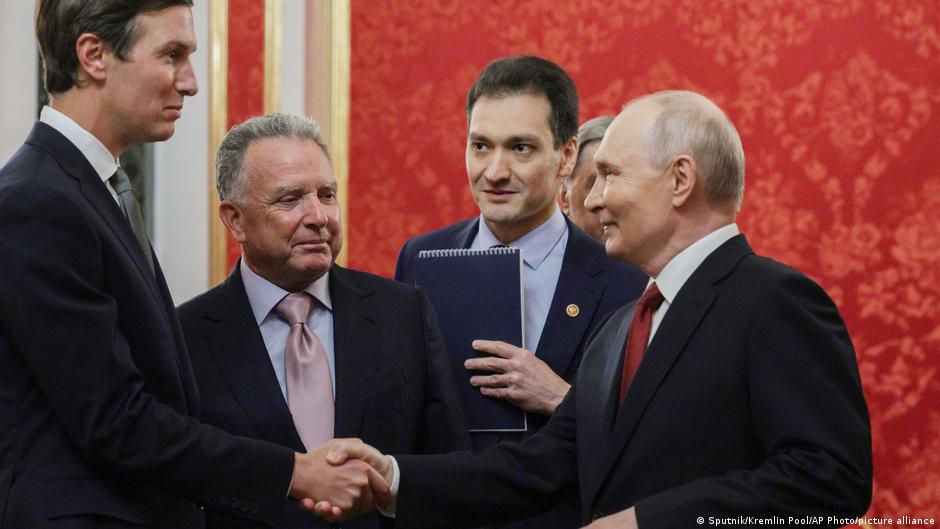
The White House said U.S. representatives Steve Witkoff and Jared Kushner discussed “concrete plans” with Russian President Vladimir Putin on further steps toward ending the war in Ukraine, setting up a new round of diplomacy that could carry significant consequences for Washington, U.S. companies and the broader business outlook tied to the conflict.
A White House official told AFP overnight on Sunday, September 6, that the American envoys had discussed specific plans during their meeting with Putin and were now looking forward to “no less productive meetings” with Ukrainian President Volodymyr Zelensky in Kyiv. The plans, according to the official, are expected to be made public “in the coming weeks.”
The U.S. delegation included Witkoff, the U.S. president’s special envoy, and Jared Kushner, Donald Trump’s son-in-law. Trump also announced a new diplomatic initiative aimed at ending the war, saying Witkoff and Kushner had carried with them a plan “to end the war,” AFP reported. The president did not specify whether the proposal would involve transferring Ukrainian territory to Russia. He said only: “We have an idea for peace.”
Washington Faces a High-Stakes Diplomatic Test
For Washington, the initiative immediately raises questions that extend beyond diplomacy. Any framework for ending the war in Ukraine would affect U.S. defense contractors, energy exporters, agricultural markets, reconstruction firms and multinational companies that have spent years adjusting to sanctions, supply chain disruption and geopolitical risk tied to Russia’s invasion.
The administration’s next steps will also be watched closely on Capitol Hill, where Ukraine policy has become a defining issue in debates over U.S. foreign commitments, defense spending and the use of American leverage abroad. If the plan includes concessions that Kyiv or European allies view as unacceptable, it could trigger political resistance in Washington. If it produces a credible path toward de-escalation, it could shift expectations for military aid, sanctions enforcement and postwar investment planning.
After leaving Moscow, Kushner and Witkoff are due to travel to Kyiv for their first talks with Zelensky following the Putin meeting. Flight-tracking data from Flightradar24 showed that the Boeing C-32A carrying the U.S. special envoys landed at 1:30 a.m. local time at the airport in Rzeszow, Poland. The aircraft departed Moscow’s Vnukovo airport and flew west while avoiding Belarus, then crossed Latvian, Lithuanian and Polish airspace. The envoys are expected to continue to the Ukrainian capital by train.
“The U.S. envoys look forward to no less productive meetings that will take place in Ukraine,” a White House source in Washington told AFP.
Moscow described the talks with Putin as unusually direct. Yuri Ushakov, an aide to the Russian president, told Russian journalists that the American delegation had presented “several ideas” on how the war in Ukraine could be brought to an end. He said the U.S. representatives had prepared carefully for the trip and had not only expressed interest in quickly ending hostilities but also offered possible routes toward a settlement.
“Overall, it can be said that the talks were timely and very useful for both sides,” Ushakov said, according to Interfax. He added that Putin had confirmed Russia’s willingness to continue working with the Americans to seek “political and diplomatic” solutions.
Business Impact Hinges on the Terms
The details matter for U.S. businesses because the economic consequences of the war are already embedded in multiple sectors. Defense firms have been tied to replenishment and aid packages. Energy companies have benefited from shifts in European demand away from Russian supplies. Grain markets have reacted to disruption around Ukrainian exports. Banks, insurers and logistics companies have had to navigate sanctions and heightened compliance demands.
A peace plan that freezes the conflict, reduces hostilities or begins a negotiated settlement could eventually change those calculations. It could lower some geopolitical risk premiums, reopen discussions about reconstruction contracts and reshape expectations for U.S. and European sanctions. But a proposal viewed as rewarding Russian territorial gains could also deepen political divisions, create uncertainty for companies operating in Europe and complicate long-term investment decisions.
According to RBC, the Russian side gave the Americans its assessment of the battlefield situation in Ukraine, highlighting what it described as successes by the Russian army and expressing “confidence in achieving the set objectives.” The report said Trump’s envoys promised to use that information during their talks in Kyiv.
Zelensky, for his part, spoke by telephone with the U.S. presidential envoys while they were in Russia and said he was ready to halt strikes on Moscow for the next three days. In a social media post, he said a plan for diplomatic measures in Kyiv involving the American team had been approved.
“We are waiting for Steve Witkoff and Jared Kushner and are ready for a substantive conversation,” Zelensky said.
The sequence of events places the White House in the center of a delicate diplomatic triangle. The U.S. team has heard Moscow’s terms and battlefield narrative, is preparing to meet Kyiv, and has signaled that more detailed proposals may be disclosed soon. For American businesses, investors and lawmakers, the central question is whether the initiative produces a practical diplomatic path or adds another layer of uncertainty to a war that has already reshaped global markets and U.S. political debate.